How Google Ads Agencies Are Using AI to Manage 20+ Client Accounts Without Hiring
The agencies growing fastest right now aren't hiring more account managers. They built a system that monitors every client account daily using AI — and surfaces exactly what needs a human decision.
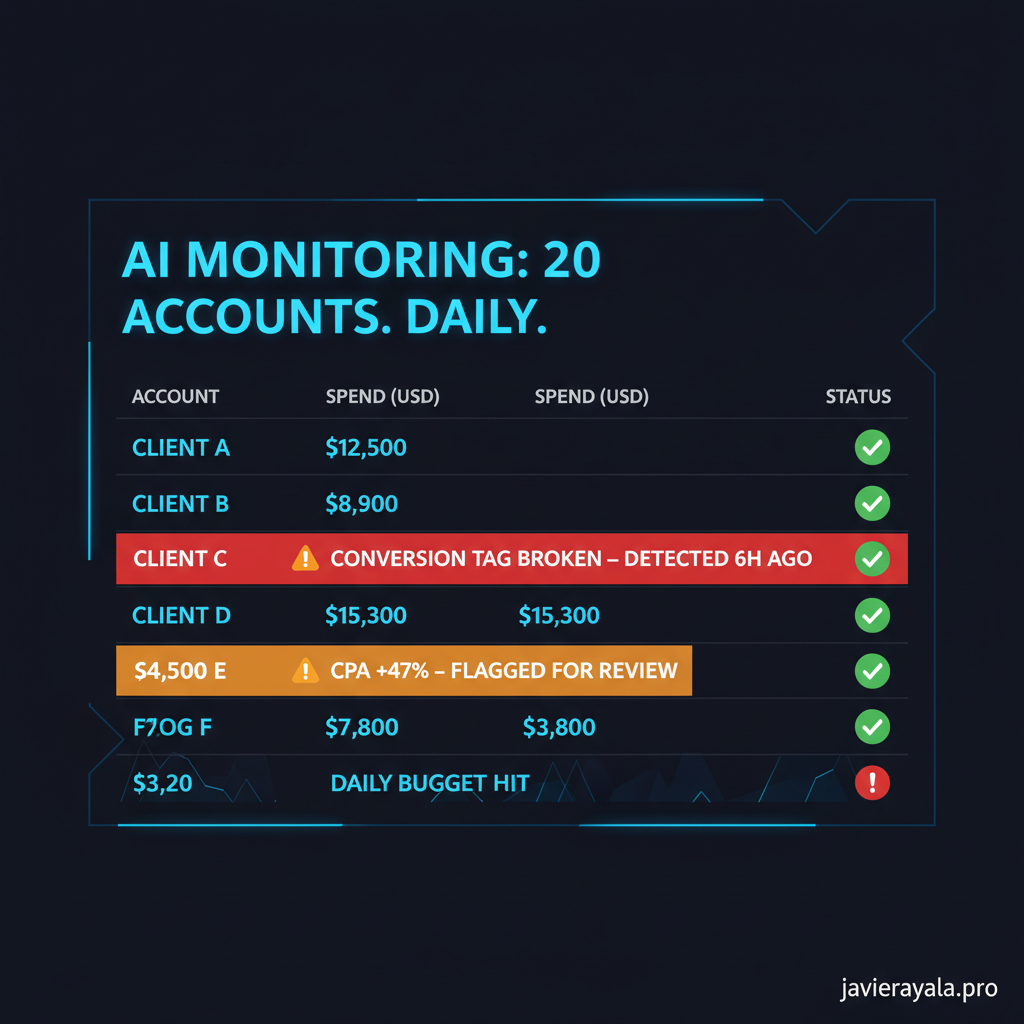
There's a ceiling every Google Ads agency hits around 10–15 clients. You can feel it before you can name it. Once you understand the throughput problem, the next step is building the monitoring system that catches issues before your clients do.
Response times slow down. You start catching problems after clients notice them. The weekly review that used to take 2 hours now takes 6. You bring in another account manager, split the book, and for about 90 days things feel manageable again — until they don't.
The agencies breaking through that ceiling aren't hiring faster. They're building differently.
The Math Problem Every Growing Agency Hits
Let's put numbers on what manual MCC management actually costs you in time.
Say you manage 20 client accounts. A proper weekly review — search term audit, bid performance, conversion check, quality score scan, budget pacing — takes 45 minutes per account if you're thorough. That's 15 hours a week just on reviews. Before reporting. Before client calls. Before new campaign builds.
Most agencies don't have 15 hours. So they compress. Reviews become 15-minute spot checks. The search term report gets skimmed. The conversion tracking tag that broke on Tuesday gets caught on Friday when the client calls asking why leads stopped.
This isn't incompetence. It's physics. There are only so many hours in a week, and Google's algorithm doesn't care about your calendar.
What's Actually Happening in Your MCC Right Now
Google's Smart Bidding system processes millions of signals per day — device, time, location, audience, query intent, competitor auction activity. It adjusts bids on every single impression.
Your team reviews accounts once a week.
That gap — seven days of algorithm changes that no human reviewed — is where client money disappears. And it compounds. A CPA that drifted 15% higher in week one becomes a client conversation in week four, when it's 60% higher and they're questioning the entire relationship.
In a portfolio of 20 accounts, at any given moment, statistical reality says at least 3–4 of them have an active problem you don't know about:
- A conversion tag that stopped firing after a website update
- An auto-applied recommendation that changed match types without approval
- A campaign Google upgraded to Performance Max that's now cannibalizing branded traffic
- An ad that got disapproved 5 days ago — impressions down 40%, client hasn't said anything yet
- A budget that hit its monthly cap on the 22nd and has been off for 8 days
None of these require a strategic decision. They require detection. And detection at scale is exactly what humans are bad at.
What AI Actually Does in an MCC Context
The phrase "AI-powered" gets used loosely enough that it's worth being specific about what this actually means for agency MCC management.
The system runs a structured diagnostic across every account in the portfolio — daily, not weekly. It's checking a defined set of conditions:
Conversion tracking health. Is every conversion action firing? Has the volume changed more than 20% day-over-day with no corresponding change in spend or traffic? A sudden drop in conversions on a Thursday with flat spend is almost always a broken tag — not a market shift.
CPA drift alerts. Not just "CPA is high" — but "CPA in this campaign has increased 35% over the last 7 days while impression share is flat." Smart Bidding needs clean signals to self-correct — catching drift early gives it the chance to recover. That's a bid strategy that's learning in the wrong direction. It needs intervention before the client's monthly report.
Search term bleed. New irrelevant queries showing up in broad or phrase match campaigns, spending without converting. In a 20-account MCC, this is happening somewhere every single day. AI flags it; a human adds the negatives in 3 minutes.
Auto-applied changes. Google's recommendation engine is aggressive. It will change bid strategies, add keywords, expand match types, and modify ad copy — all automatically, unless you've explicitly disabled auto-apply. Most accounts have some version of it on. The system catches these changes and flags them for review.
Ad approval status. Any ad that goes from approved to disapproved triggers an immediate alert. Not a weekly summary — same day.
Budget pacing. Is spend on track to exhaust the monthly budget early? Is a campaign dramatically underpacing because of a targeting issue? Both cost clients money. Both are invisible without daily monitoring.
How This Changes the Agency Workflow
The shift isn't from "human does everything" to "AI does everything." That's not how it works and it's not how it should work. Strategic decisions — campaign structure, audience strategy, landing page recommendations, budget allocation across campaigns — still require a human who understands the client's business.
What changes is the detection layer.
Instead of an account manager spending 45 minutes per account hoping they catch the right thing, they start each morning with a prioritized list: Account 7 has a conversion drop. Account 12 had an auto-applied change to Smart Bidding. Account 3's top ad got disapproved. Account 19 is pacing to exhaust budget 8 days early.
Those are four accounts that need attention today. The other 16 are clean. The account manager spends 90 minutes fixing real problems instead of 6 hours scanning dashboards hoping to find them.
In a portfolio we manage directly, this system identified $8,850 in wasted spend in a single month across 26 accounts — spend that had been accumulating in search terms, mis-configured campaigns, and budget misallocations that weekly manual reviews had missed for 60–90 days.
The Retention Effect
Client churn in Google Ads agencies almost never happens because a client suddenly decides to leave. It happens because a problem went undetected, compounded over weeks, and by the time there's a difficult conversation, the client has already started looking at alternatives.
The agency that catches the CPA increase in week one has a very different conversation than the agency that gets an angry email in week four.
"We noticed your cost per lead increased 18% over the last 7 days — here's what we found and here's what we changed" is a retention email. It shows the client they're being watched, not just billed.
"We're sorry your results have been declining — we're not sure exactly when it started but we're on it now" is a churn email. It confirms exactly what clients fear about agencies: that nobody is actually paying attention.
Daily AI monitoring makes the first conversation possible at any account scale. The account manager doesn't have to have caught it manually — the system did.
What You Actually Need to Build This
The good news is that the core of this system doesn't require a custom software build. The components exist:
- Google Ads Scripts — free, runs inside your MCC, can check conditions across all accounts and send email alerts. Requires someone who can write or maintain JavaScript.
- Optmyzr or similar tools — purpose-built for multi-account monitoring with rule-based alerting. Monthly fee, no code required.
- Custom AI layer — for agencies with large portfolios or specific diagnostic needs, a custom system that pulls data via the Google Ads API and applies pattern detection logic. Higher setup cost, highest flexibility.
The right choice depends on your portfolio size and technical capacity. What matters is that something is running daily — not a human, not a weekly process — something automated that catches the problems that compound silently.
The Competitive Gap This Creates
Most agencies your clients have worked with before operate on the weekly review model. It's the industry default. It's what's taught, what's expected, what gets quoted in proposals.
An agency that can say "we have an automated system that monitors every account in your portfolio daily and sends us alerts when something moves outside of normal parameters" is making a claim that very few competitors can match — and that every client will immediately understand the value of.
It answers the question clients never say out loud but always think: Is anyone actually watching my account, or am I paying a retainer for a monthly report?
If you're running 5 or more client accounts from an MCC and want to see what a daily AI monitoring pass finds in your portfolio — accounts your team reviewed last week — message me directly. I'll run a free scan on one account and show you specifically what was missed.
Get a Free AI Scan of Your Google Ads
Enter your email and I'll connect directly to your account — then show you exactly where your budget is going, what's wasting spend, and what to fix first.