Google Ads Smart Bidding: How AI Lowers Your Cost Per Lead
Smart Bidding uses Google's AI to optimize your bids in real time. Here's how it works, when to use it, and why most local businesses set it up wrong.
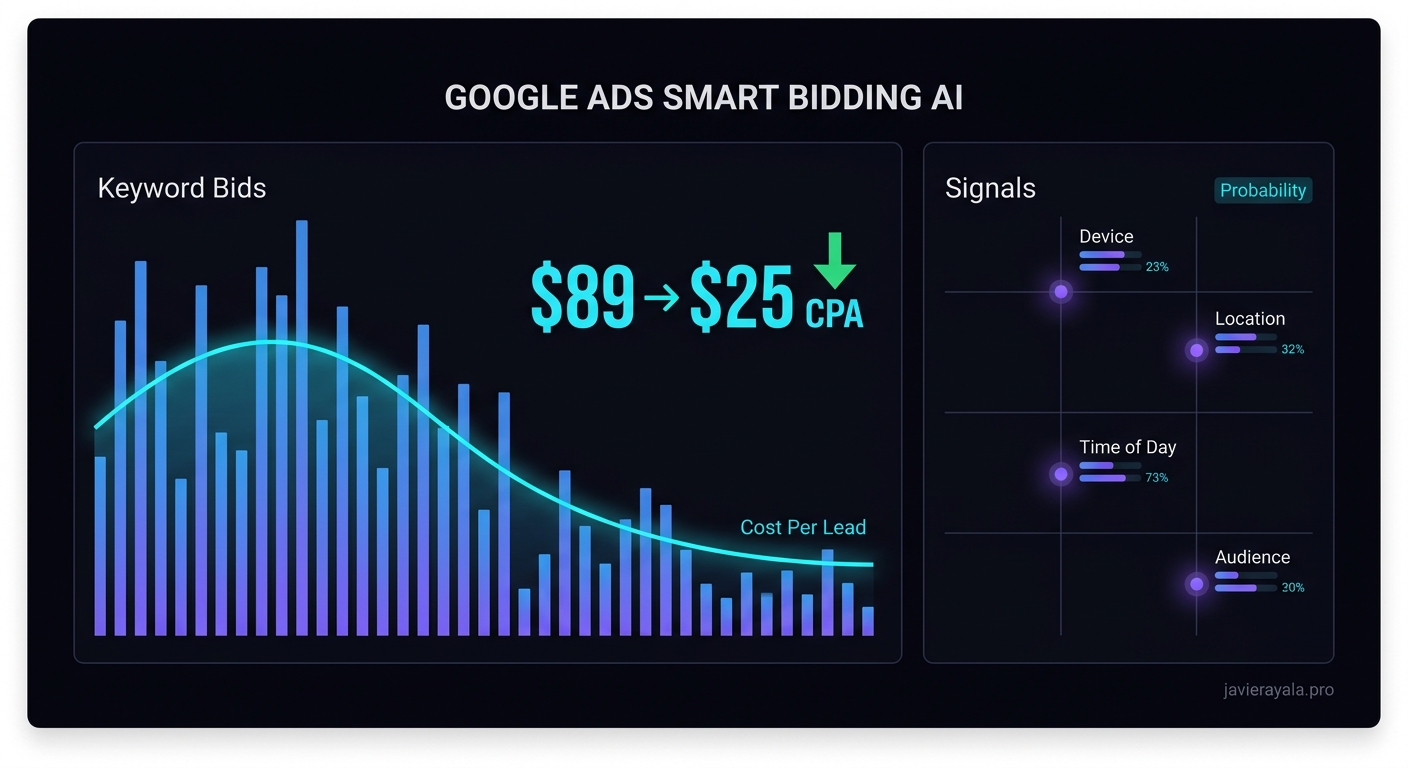
If you're still manually adjusting bids on your Google Ads campaigns, you're working against the most powerful optimization engine in digital advertising. Google processes over 70 billion search queries per day. For every one of those searches, its AI evaluates hundreds of signals in milliseconds to predict how likely a given user is to convert — and adjusts bids accordingly.
That's what Smart Bidding is. And when it's set up correctly, it consistently outperforms manual bidding for local service businesses.
What Smart Bidding Actually Does
Smart Bidding is Google's suite of automated bid strategies that use machine learning to optimize for conversions or conversion value. The most relevant strategies for local service businesses are:
- Maximize Conversions: Spends your budget to get as many conversions as possible. Good starting point for accounts with limited data.
- Target CPA (Cost Per Acquisition): Tries to get conversions at or below a target cost you set. Best for accounts with 30+ conversions per month.
- Target ROAS (Return on Ad Spend): Optimizes for revenue rather than lead volume. Most relevant for e-commerce; less common for service businesses.
- Maximize Conversion Value: Useful when different leads are worth different amounts — for example, a roofing replacement lead is worth more than a repair lead.
What separates Smart Bidding from manual strategies is the signal volume. When you set a bid manually, you're making one decision based on the keyword. When Smart Bidding makes a bid, it's evaluating the keyword plus the device, location, time of day, user's search history, browser, whether they've visited your site before, and dozens of other contextual signals — simultaneously, in real time.
Why Most Local Accounts Use It Wrong
Smart Bidding has a reputation problem among some advertisers because they've seen it fail. In most cases, it fails for one of three reasons:
- Not enough conversion data. Smart Bidding needs a minimum of 30–50 conversions per month to learn effectively. Below that threshold, the algorithm doesn't have enough signal and will make poor decisions. Switching to Target CPA on an account with 8 conversions per month will usually make performance worse.
- Broken conversion tracking. If your conversions aren't tracked accurately — missed phone calls, double-counted form fills, no offline conversion imports — the algorithm is optimizing for the wrong thing. It thinks it's doing well when it's not.
- Setting an unrealistic Target CPA. If your historical cost per lead is $120 and you set a Target CPA of $40, the algorithm will restrict your bids so aggressively that you'll barely show up. The target needs to reflect your actual data, at least initially.
The Right Way to Transition to Smart Bidding
Don't flip the switch overnight on a live campaign. Here's the sequence that works:
- Step 1 — Fix conversion tracking first. Confirm that phone calls (with a minimum call duration of 60+ seconds), form submissions, and any other lead actions are being tracked as conversions. If you run a service business, call tracking is non-negotiable.
- Step 2 — Start with Maximize Conversions. Before setting a Target CPA, let Maximize Conversions run for 4–6 weeks. This builds conversion history and gives the algorithm the data it needs.
- Step 3 — Set a realistic Target CPA. After you have 60+ conversions in the account, calculate your actual average cost per lead and set your target at or slightly above that. You can gradually reduce the target over time as the algorithm adapts.
- Step 4 — Give it time before judging. Smart Bidding goes through a learning period of 1–2 weeks whenever significant changes are made. Don't panic during learning phase fluctuations and don't make major changes mid-learning period.
What the AI Is Evaluating on Every Auction
This is where Smart Bidding genuinely can't be replicated manually. On every single auction, Google's model evaluates signals including:
- Device type and operating system
- Physical location and location intent in the query
- Time of day and day of week
- Query text and search history
- Whether the user has previously visited your site or interacted with your ads
- Audience list membership (remarketing lists, customer match, similar audiences)
- Browser and app environment
A human managing bids manually might adjust for time of day and device. The AI adjusts for all of these simultaneously, for every auction, every time. At scale, that produces significantly better cost-per-lead outcomes than manual management.
What to Expect When It's Working
When Smart Bidding is set up correctly — clean conversion data, enough volume, realistic targets — here's what typically happens within 60–90 days:
- Cost per lead decreases as the algorithm gets better at identifying high-intent searches.
- Impression share stabilizes on the searches that actually convert, rather than spreading budget across irrelevant queries.
- You spend less time manually tweaking bids and more time on creative, landing pages, and offer testing — the things that move the needle long-term.
Smart Bidding isn't magic. It's a tool that amplifies good account structure and accurate data. If your account is poorly structured or your tracking is broken, it will amplify those problems too.
If you want to know whether your account is ready for Smart Bidding — and what's holding back your current performance — get a free Google Ads AI Scan. We'll review your conversion setup, bidding strategy, and data quality and tell you exactly what to fix first. Or see how our Google Ads AI management keeps Smart Bidding fully optimized on an ongoing basis.
Get a Free AI Scan of Your Google Ads
Enter your email and I'll connect directly to your account — then show you exactly where your budget is going, what's wasting spend, and what to fix first.