Google Ads AI for Med Spas: How to Fill Your Calendar with High-Value Clients
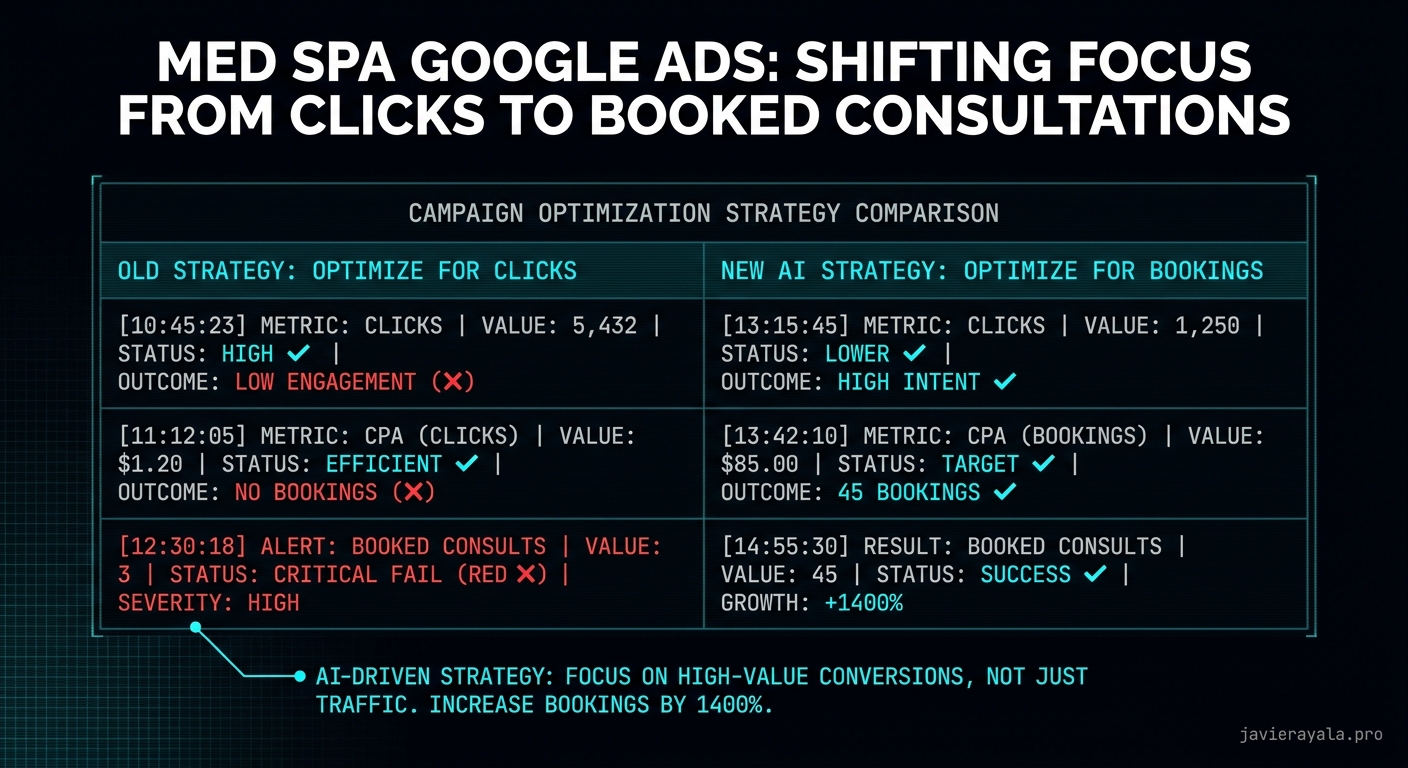
Med spa Google Ads campaigns fail for one reason: they optimize for clicks instead of booked consultations. Here's how AI bidding fixes that and cuts your cost per booking by 40%.
A Botox patient is worth $400–$600 per visit. A filler client who stays loyal is worth $3,000–$8,000 over three years. A body contouring consultation that converts to a package is worth $2,000–$6,000 in a single transaction. Med spa is one of the highest-value Google Ads verticals for local businesses — and one of the most wasted.
The typical med spa campaign generates form fills and phone calls at $80–$180 per lead, converts a fraction of those to booked consultations, and leaves the practice owner wondering whether Google Ads actually works. The problem isn't Google Ads. It's that the campaign is optimizing for the wrong thing, at the wrong stage of the funnel, for the wrong searches.
The Med Spa Google Ads Problem
Med spa searches span an enormous range of intent. "What is Botox" is curiosity. "How much does Botox cost in [city]" is research. "Botox consultation near me" is purchase intent. "Book Botox appointment [city]" is a buyer with a credit card. These searches look similar in a broad match campaign, but they're completely different in value.
Most med spa campaigns target all of them — and pay for all of them — without distinguishing between the person doing research at 11pm and the person looking to book their appointment this week. The AI bidding system can only optimize toward what it's been told matters. If it's been told that any form submission is a conversion, it learns to generate form submissions — including from researchers who fill out a contact form to ask about pricing and never book.
The fix is more specific than "better targeting." It's about telling the algorithm precisely what a valuable conversion looks like and giving it enough data to find more of them.
How AI Bidding Works for Med Spas
Smart Bidding uses machine learning to set bids on every auction individually, based on the likelihood that a specific search, from a specific user, at a specific moment, will result in your defined conversion. The more precisely you define that conversion, and the more conversion data you provide, the better the system performs.
For med spas, the hierarchy of conversion quality typically looks like:
- Highest value: Booked consultation or appointment (confirmed, on the calendar)
- High value: Phone call lasting 2+ minutes (likely a real inquiry)
- Medium value: Form submission requesting a consultation
- Low value / noise: Page visit, short phone call under 60 seconds, general contact form without service specified
Most med spa campaigns track the medium and low-value actions and call them conversions. The AI then finds the searchers most likely to fill out a generic form — which includes a lot of price shoppers and researchers who never book. When you shift the primary conversion to high-value actions only, the AI recalibrates and starts finding a different, higher-intent audience.
The tradeoff is volume. Tracking only booked consultations means fewer conversion events, which means the AI learns more slowly. The practical solution: use booked consultations as the primary conversion, phone calls 2+ minutes as a secondary conversion with lower value assigned, and form submissions as an import from your CRM showing which ones actually became appointments. Give the algorithm the full picture.
The Treatment-Level Campaign Structure
The highest-performing med spa Google Ads accounts don't run a single "med spa services" campaign. They run separate campaigns by treatment category, because the search intent, the competition, and the conversion economics are different for each service.
Injectables (Botox/Dysport/fillers). Highest search volume, most competitive, most price-sensitive searchers. Keywords: "[treatment] near me," "[treatment] [city]," "[treatment] specials," "[treatment] consultation." Needs a landing page that addresses price directly (or at least offers a consultation to discuss), shows before/after results, and has an immediate booking CTA. Fast response time critical — injectable buyers are comparison shopping.
Body contouring (CoolSculpting, Emsculpt, etc.). Lower search volume, higher average transaction, longer decision cycle. Searchers often need education before booking. Landing page should include treatment explanation, expected results, and patient testimonials. Offer a free consultation as the conversion — these patients need to see you in person before committing to a package.
Skin treatments (laser, IPL, chemical peels, microneedling). Moderate volume, seasonal variation (fall/winter tend to be stronger for laser), skin-type specific intent. Keywords targeting specific concerns ("dark spots laser treatment," "acne scarring IPL") convert better than generic service keywords.
Membership or package promotions. If you offer a membership program or treatment packages, dedicated campaigns during promotional periods can have exceptional ROI. The audience is existing-patient lookalikes and high-intent buyers — smaller volume, very high conversion value.
Landing Pages: Where Med Spa Campaigns Win or Lose
A med spa Google Ads campaign sending traffic to the homepage is leaving significant revenue on the table. The landing page match to ad intent is one of the highest-leverage variables in any campaign — for med spas specifically, because the aesthetic and trust signals of the page directly affect conversion rate.
What a high-converting med spa landing page needs:
- Treatment-specific headline that matches the search ("Botox in [City] — New Patient Consultations Available")
- Before/after gallery visible above the fold — med spa is a visual product, and before/afters build confidence faster than any copy
- Provider credentials — board certification, years of experience, specific training. Patients are injecting substances into their face; credentials matter.
- Pricing transparency or clear next step — either show starting prices or make "free consultation" the explicit, low-friction offer
- Single CTA, prominently placed — phone number in large text, booking button, or both. No navigation menu. No links out.
- Social proof — Google review rating, real patient testimonials with names and photos
Most med spa homepages fail on the last two. They have navigation menus that send visitors to five other pages, and their testimonials are anonymous ("A happy client") which carries zero weight for a prospect making a trust decision about a medical aesthetic service.
What a Realistic Cost Per Booking Looks Like
For a well-optimized med spa Google Ads campaign in a competitive market:
- Cost per lead (form fill or phone call): $40–$90
- Lead-to-consultation booking rate: 30–60% (depends heavily on follow-up speed)
- Effective cost per booked consultation: $70–$200
- Consultation-to-treatment conversion: 50–80%
- Effective cost per new paying client: $90–$300
Against a first-visit transaction of $400–$600 and a lifetime value of $2,000–$8,000, a $200 cost per new client is highly profitable. The accounts that report "Google Ads doesn't work" for med spas are usually seeing $150–$200 cost per lead (not per client) and comparing it to the wrong benchmark.
The fastest way to cut cost per booking in half is follow-up speed. A lead who calls and reaches a human converts at 70–80%. A lead who calls, gets voicemail, and doesn't get a callback for four hours has a 20–30% conversion rate. The AI can optimize your bids perfectly and still produce poor results if the front-desk operation isn't capturing the leads the campaign generates.
Getting Started
If you're running Google Ads for your med spa and your cost per booking feels too high, the audit should start at conversion tracking — verify what's actually being counted — then at campaign structure, then at landing pages. In that order. Fixing bids before fixing tracking is optimizing toward the wrong goal.
If you're starting from scratch, begin with one campaign targeting your highest-value service (usually injectables for volume, or body contouring for revenue). Get the tracking clean, the landing page built, and 30 conversions through the system before expanding. Smart Bidding needs a minimum conversion volume to perform — spreading budget across five campaigns with 5 conversions each is less effective than one campaign with 50.
For a free audit of your med spa Google Ads account — what it's optimizing toward, where budget is going, and what the fastest improvements are — message me directly. I'll review the account and show you specifically what to fix first.
Want a Free 1-on-1 Strategy Call?
Enter your email and we'll send you a link to book a free 30-minute call — we'll audit your current marketing and map out exactly what to build.